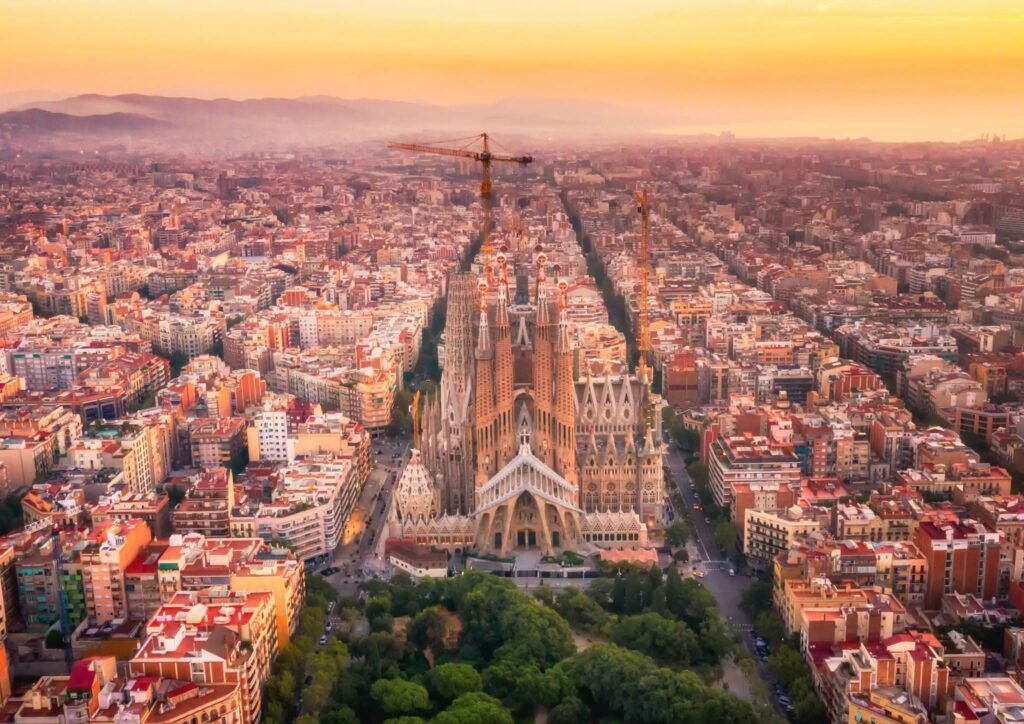
Picture standing inside a basilica where sunlight pours through stained glass in colors that shift with the time of day, columns branching upward like a stone forest canopy, all part of a building that its own architect knew he’d never live to see finished. That’s the Sagrada Familia, Antoni Gaudi’s masterwork and still, remarkably, a construction site well over a century after ground was first broken, and it anchors a Barcelona trip built almost entirely around one visionary architect’s imagination.
Visiting the Sagrada Familia, Gaudi’s Unfinished Masterpiece
Basic entry with an audio guide to the Sagrada Familia runs roughly €18 to €26 depending on current pricing, and booking tickets online well in advance is essential since the basilica limits daily visitors and same-day tickets frequently sell out entirely, especially during peak season. Adding a guided tour, running $100 to $200 per person when combined with Park Guell, offers deeper context on Gaudi’s symbolism, from the nativity facade’s organic, nature-inspired carvings to the passion facade’s stark, angular depiction of Christ’s crucifixion.
Wandering the Mosaic-Covered Park Guell
Park Guell, a public park built on a hillside in the Gracia district, showcases Gaudi’s playful use of colorful mosaic tiles across benches, structures, and the park’s famous serpentine terrace, with sweeping views over the city from its highest point. While general park entry has historically been discussed as free in some areas, the monumental zone containing Gaudi’s most famous mosaic structures now requires a timed ticket, so checking current pricing and booking ahead avoids disappointment at the gate.
Combining Sagrada Familia and Park Guell in One Day
Since both sites are Gaudi’s signature works and sit a reasonable distance apart, many visitors book a combined skip-the-line tour bundling both attractions with transportation between them, typically running $130 to $200 per person for guided tours lasting three to four hours total. Independent travelers on a budget can also visit both sites separately using individual timed tickets and the city’s metro system, saving money at the cost of a bit more logistical planning.

BARCELONA REVEALED
Your Experience in 4 Days
DAY 1: LAS RAMBLAS & THE GOTHIC QUARTER
Las Ramblas
Location: La Rambla, 08002 Barcelona (start at Plaça de Catalunya)
Fee: Free to walk; La Boqueria snacks from €3 (verify before you go)
A 1.2 km tree-lined promenade running from Plaça de Catalunya to the harbour, laid out over a medieval stream bed. Visit Mercat de la Boqueria and the Gran Teatre del Liceu façade.

Barrio Gótico (Gothic Quarter)
Location: Around Barcelona Cathedral, Plaça Sant Jaume, 08002
Fee: Free streets; Cathedral ~€9 (free worship-hours entry in the morning) (verify before you go)
Built on the Roman city of Barcino, its lanes hold the cathedral, Roman temple columns and Plaça del Rei. Much of the ‘Gothic’ look is a 20th-century restoration blending real medieval stone.

🍽️ Day 1 Dining
- BreakfastGranja Dulcinea 📍 Location
Famous for thick hot chocolate and churros in the Petritxol lane. - LunchCan Culleretes 📍 Location
Barcelona’s oldest restaurant (1786) serving classic Catalan dishes. - DinnerLos Caracoles 📍 Location
Rustic spit-roast chicken and snails near Plaça Reial.
DAY 2: SAGRADA FAMILIA & PARC GÜELL
Basílica de la Sagrada Familia
Location: Carrer de Mallorca 401, 08013
Fee: From ~€26 with timed entry; towers extra (verify before you go)
Gaudí’s unfinished masterpiece, begun in 1882 and still under construction. Its forest-like nave and stained glass turn sunlight into colour.

Parc Güell
Location: Carrer d’Olot, 08024 (Gràcia / Carmel)
Fee: ~€10 for the Monumental Zone; timed tickets required (verify before you go)
Originally a failed garden-city project, Gaudí’s hilltop park features the mosaic dragon, serpentine bench and sweeping city and sea views.

🍽️ Day 2 Dining
- BreakfastGranja Petitbo 📍 Location
Bright brunch spot on Passeig de Sant Joan. - LunchCan Travi Nou 📍 Location
Catalan masia dining with garden terrace in Horta. - DinnerTapas 24 📍 Location
Creative Catalan tapas in the Eixample.
DAY 3: PASSEIG DE GRÀCIA & BARCELONETA
Casa Batlló
Location: Passeig de Gràcia 43, 08007
Fee: From ~€35 with digital guide (verify before you go)
Gaudí’s 1904-06 remodel of an existing house: a skeletal facade, a dragon-spine roof and an undulating sea-inspired light well.

Casa Milà (La Pedrera)
Location: Passeig de Gràcia 92, 08008
Fee: From ~€29 (day visit) (verify before you go)
Completed in 1912, this stone-fronted apartment block has no load-bearing interior walls, and its chimney-warrior rooftop is a Gaudí signature.

Playa de la Barceloneta
Location: Passeig Marítim de la Barceloneta, 08003
Fee: Free (verify before you go)
Once a fishermen’s quarter, it became the city’s main beach after the 1992 Olympic waterfront remodel. The grid of narrow streets behind it is full of old seafood bars.

🍽️ Day 3 Dining
- BreakfastSyra Coffee 📍 Location
Specialty coffee and pastries in the Eixample. - LunchCervecería Catalana 📍 Location
Popular tapas and montaditos, arrive early. - DinnerCan Solé 📍 Location
Seafood and paella in Barceloneta since 1903.
DAY 4: MUSEU PICASSO & EL BORN
Museu Picasso
Location: Carrer de Montcada 15-23, 08003
Fee: ~€14; free Thursday evenings and first Sundays (reserve) (verify before you go)
Housed in five medieval palaces, it holds more than 4,000 works tracing Picasso’s formative years in Barcelona, including Las Meninas studies.

Barrio El Born
Location: Passeig del Born / Santa Maria del Mar, 08003
Fee: Free; Santa Maria del Mar ~€5 (verify before you go)
A former medieval jousting district now filled with boutiques, bars and the cathedral-like Santa Maria del Mar, built by local people in the 14th century.

🍽️ Day 4 Dining
- BreakfastHofmann Pastisseria 📍 Location
Famed for croissants, near Carrer Flassaders. - LunchBar del Pla 📍 Location
Modern Catalan tapas on Carrer Montcada. - DinnerCal Pep 📍 Location
Counter-style seafood tapas, queue early.
Practical Travel Guide
How much does it cost to visit the Sagrada Familia?
Basic entry with an audio guide runs approximately €18 to €26, while guided tours combining Sagrada Familia and Park Guell with transportation typically run $130 to $200 per person, and booking online well in advance is essential since tickets regularly sell out.
How do you get from Sagrada Familia to Park Guell?
The two sites sit roughly 2.5 miles apart, and while a metro connection with one transfer takes about 20 to 30 minutes, most combined guided tours include private bus transportation between the two, saving time and the hassle of navigating unfamiliar transit for first-time visitors.
How many days should you spend in Barcelona?
Four days covers the main Gaudi sites, the Gothic Quarter, and at least one beach day comfortably, while travelers wanting to add day trips to nearby Montserrat or the Costa Brava coastline should plan for five to six days.
What should you pack for Barcelona?
Comfortable walking shoes for the Gothic Quarter’s cobblestones and Park Guell’s hillside terrain, a swimsuit for Barceloneta Beach, modest clothing for entering the Sagrada Familia (shoulders and knees covered), and sunscreen given Barcelona’s strong Mediterranean sun.
Is it worth booking a guided tour of the Sagrada Familia instead of visiting independently?
For most first-time visitors, yes, a guided tour or at minimum the included audio guide dramatically improves the experience, since Gaudi packed the basilica with layered religious and natural symbolism that’s easy to miss without context, though independent visitors with some background reading beforehand can also have a rewarding self-guided visit.
FREQUENTLY ASKED QUESTIONS
Planning the perfect adventure doesn’t have to be complicated. To help you along the way, we’ve rounded up the most common questions every traveler asks before and during their trip.
Our Top Recommendation
The Best Way to Experience This Destination
Start planning your trip
enjoy
Barcelona offers a rare kind of city trip built almost entirely around the singular vision of one architect, whose still-unfinished masterpiece and playful mosaic park continue drawing millions of visitors more than a century after he began. Whether you’re marveling at the Sagrada Familia’s ever-shifting light or wandering Park Guell’s colorful terraces, this Catalan capital delivers art, architecture, and beach in one uniquely walkable .
See the full itinerary